
Last updated September 25, 2026
How to Hire a ADU Contractor in Pomona: A Step-by-Step Guide
The most expensive mistake in hiring an ADU contractor in Pomona happens before the first nail. In a split design-then-bid model, a contractor who discovers a conflict between the architectural set and the structural engineer’s sheets has a financial incentive to solve it cheaply rather than correctly - and the designer is no longer on-site to notice. We’ve seen this gap turn a $140,000 garage conversion into a $190,000 rewrite after the city rejects the as-built condition. This guide walks you through the contract structures, license verifications, and permit-history checks that protect your project before you sign, and points you to more guides & resources for every stage of your ADU journey.
Quick Answer
To hire an ADU contractor in Pomona, verify the firm’s CSLB license classification matches your project type, check their permit completion history on Pomona’s public portal, and insist on a single-contract design-build agreement with written fixed pricing, a defined change-order trigger, and permit-delay responsibility assigned. Avoid any proposal that separates design from construction liability.
Table of Contents
- The Three Contract Structures in Pomona ADU Projects
- CSLB License Verification for Pomona ADU Work
- How to Read a Contractor’s Permit History on Pomona’s Public Portal
- The Five Contract Clauses That Matter Most
- Interview Questions That Reveal Pomona-Specific Experience
- What ADU Projects Cost in Pomona
- Common Mistakes to Avoid
- When to Call a Professional
- Frequently Asked Questions
The Three Contract Structures in Pomona ADU Projects
Every ADU project in Pomona uses one of three contract structures. The structure you choose determines who bears the risk when drawings conflict with field conditions, when the city requests corrections, or when a subcontractor’s work fails inspection.
Design-Bid-Build
You hire an architect or designer to produce a permit set. Once approved, you solicit bids from general contractors. The designer’s contract ends at permit issuance. The contractor’s contract begins at groundbreaking.
The liability gap: if the contractor finds that the foundation detail in the structural sheets cannot be executed as drawn, the contractor’s incentive is to substitute the cheapest alternative that passes inspection - not the one the designer intended. The designer has no contractual standing to intervene. In Pomona, where the Planning Department often requires revised site plans after initial submittal, this gap widens. A set approved in January may sit for three months while the contractor lines up trades; by April, Pomona’s amended parking requirements or setback interpretations may have shifted, and the designer is no longer under contract to update the drawings.
Typical cost range in Pomona: design fees of $8,000-$18,000, plus construction bids that often come in 15-30% above initial estimates because the designer’s drawings lacked constructability review. For a detailed look at where every dollar goes, see our ADU Cost Breakdown: The Pomona Homeowner’s Reference for 2026.
GC-with-Separate-Architect
A general contractor maintains a relationship with an architect but the contracts remain separate. The GC “coordinates” the design phase. This arrangement looks like design-build but lacks the single-point accountability.
The liability gap: when the architect specifies a permit set detail that the GC’s preferred subcontractor won’t execute, the GC blames the architect for impractical drawings. The architect blames the GC for value-engineering without approval. You mediate, or you pay for a redesign. In our experience reviewing competitor estimates for Pomona homeowners, this structure produces the highest rate of change orders - often 20-35% above the original contract.
Design-Build
One entity holds contract for both design and construction. The permit set is produced with full knowledge of how it will be built. The same entity that stamped the drawings is legally accountable for building to them.
At Ellery ADU Studio Pomona, this is our only model. Under Haven Standard Clause 1, the written price covers drawings through final inspection. If a conflict emerges between the architectural set and field conditions, we revise the drawings at our expense - not yours. Since 2015, we’ve designed, permitted, and built 900+ ADUs this way, including garage conversions in Pomona’s historic Lincoln Park neighborhood and new detached units in the Phillips Ranch hillside areas where slope and setback constraints demand integrated design-build thinking.
The design-build premium in Pomona is typically not a premium at all. Eliminating the designer-GC blame gap removes the hidden cost of change orders, redesign fees, and permit delays.
CSLB License Verification for Pomona ADU Work
California law requires specific license classifications for ADU construction. A contractor who holds only a C-36 Plumbing license cannot legally perform structural framing. A B General Building contractor can oversee the full project but must subcontract electrical, plumbing, and HVAC to appropriately licensed specialists.
Step-by-Step License Verification
- Visit cslb.ca.gov and search the license number. Verify the status is “Active,” the bond is current, and the workers’ compensation coverage is on file (required if the contractor employs anyone).
- Check the classification. For a full ADU project, the primary contractor should hold a B (General Building) license. C-10 (Electrical), C-36 (Plumbing), and C-20 (HVAC) must appear on the subcontractor roster for any project involving new systems.
- Review the disciplinary history. The CSLB lists citations, suspensions, and probation terms. A single citation for unlicensed subcontracting is a red flag - it suggests the contractor cuts corners on trade qualifications.
- Cross-check the business name. Some Pomona-area contractors operate under multiple DBA names. The license number should match the name on your contract exactly.
- Verify the license holder’s name appears on city permits. In Pomona, the CSLB license number must be listed on every building permit. A contractor who asks you to pull the permit yourself - “as the owner-builder” - is avoiding accountability.
Pomona’s building department, located at 505 S. Garey Avenue, requires the contractor’s license number on the permit application. If the number doesn’t match the CSLB record, the permit stalls. We’ve reviewed competitor proposals where the salesperson’s business card showed one company name and the proposed contract showed another - both supposedly operating under a single license. This is common enough that we now recommend homeowners verify the license before the first site visit, not after receiving the proposal.
For prefab and modular ADU projects, the license requirements compound. The factory may be out of state, but the California installation contractor must hold a B license plus any trade-specific classifications for on-site utility connections. Ellery coordinates systems from Abodu, Cover, and Dvele under our single-contract model, with our license number on every Pomona permit.
How to Read a Contractor’s Permit History on Pomona’s Public Portal
Pomona maintains public permit records through the city’s online portal and at the Community Development counter. A contractor’s permit history reveals more than their volume - it shows their completion rate, their relationship with inspectors, and their attention to final sign-off.
What to Look For
- Open violations: Search by address for projects the contractor completed. Any “Code Enforcement” case tied to that address suggests the contractor either failed final inspection or left work that triggered a neighbor complaint. In Pomona’s dense neighborhoods - particularly around downtown and the Cal Poly Pomona adjacency - unpermitted exterior work draws complaints quickly.
- Expired permits: A permit that expired without final inspection means the contractor either abandoned the job, failed repeated inspections, or let the permit lapse while negotiating change orders. In Pomona, permit expiration after 180 days requires full reapplication, including revised fees.
- Final inspection completion rate: Count the number of permits with “Final” status versus those still showing “Rough” or “No Final.” A completion rate below 80% indicates systemic project management problems. We’ve reviewed histories where a prominent Los Angeles County contractor had 34 open permits in Pomona, only 12 with final inspection - a 35% completion rate hidden behind glossy marketing.
- Permit type consistency: A contractor whose Pomona history shows only bathroom remodels and patio covers has no demonstrated experience with ADU-specific requirements: fire separation, independent utility metering, or Pomona’s R-1 zone density calculations.
- Timeline patterns: Permits that sit in “Plan Check” for 90+ days may indicate the contractor submits incomplete drawings repeatedly. Pomona’s plan check target is 20 business days for a complete ADU submittal. Repeated extensions suggest the contractor is learning ADU code on your dime.
How to Access the Records
Pomona’s public portal at pomona.gov allows permit search by address. For contractor-specific history, visit the Community Development Department and request a permit search by license number. There is no fee for this search. Bring the contractor’s license number and a list of addresses from their reference list. Cross-reference: do the permits match the addresses they provided? Are the permit dates consistent with the “completion” stories they told?
In our experience, the contractors most eager to provide references are often the ones whose permit history doesn’t match their claims. A contractor who built “dozens of ADUs in Pomona” should have dozens of permits to show. Ask to see them.
The Five Contract Clauses That Matter Most
The contract is where liability lives or dies. These five clauses determine whether your fixed-price ADU stays fixed, and who pays when it doesn’t.
1. Scope Definition
The contract must attach the full permit set, the structural calculations, and the finish schedule as exhibits. Any item not in these exhibits is not in scope. Vague language - “standard finishes,” “builder’s grade,” “as approved by owner” - creates the ambiguity that feeds change orders.
Under Haven Standard Clause 3, our contracts specify every material by manufacturer and product line: James Hardie siding in Monterey Taupe, not “cement board siding in a tan color.” This specificity eliminates the “I thought you meant…” conversations that derail budgets.
2. Allowance Line Items
Allowances are budget placeholders for owner-selected items: tile, fixtures, appliances. The contract must state the allowance amount, the source catalog or vendor, and what happens when the actual selection exceeds or undershoots the allowance.
A common Pomona scenario: a contractor includes a $4,000 appliance allowance based on big-box retail pricing. The homeowner selects appliances from a specialty vendor in Claremont. The actual cost is $6,200. Without clear allowance language, this becomes a $2,200 change order - or a dispute. Our contracts specify: allowance overruns are owner responsibility, allowance savings are credited to the final invoice. No ambiguity.
3. Change-Order Trigger Language
The contract must define exactly what triggers a change order: concealed conditions (asbestos, undocumented utilities), owner-requested modifications, or code changes after permit issuance. Everything else is the contractor’s responsibility.
Under Haven Standard Clause 5 (No Surprises), the scope is locked at signing. If our field crew discovers that Pomona’s soil conditions require deeper footings than the geotechnical report indicated, we absorb that cost. The trigger was not in the contract’s defined list. This is the difference between a fixed price and a “fixed price plus weasel words.”
4. Lien Release Schedule
California law allows subcontractors and material suppliers to file mechanics liens against your property if the general contractor fails to pay them. Your contract should require lien releases from every subcontractor and supplier before each progress payment.
The schedule must match the payment schedule: 10% deposit, 25% at foundation, 25% at rough inspection, 35% at final inspection, 5% retention until lien period expires. Each payment is contingent on receiving unconditional lien releases for all work to date. A contractor who resists this structure is either undercapitalized or planning to float your payments to cover other projects.
5. Permit-Delay Responsibility
Pomona’s ADU permit timeline varies by project complexity and plan-check backlog. The contract must assign responsibility for delays: who pays carrying costs if the permit sits in plan check for four months instead of two?
Our contracts specify: delays caused by incomplete submittal are our responsibility; delays caused by city backlog are shared after 60 days; delays caused by owner decisions (finish selection, change orders) are owner responsibility. Each trigger is defined. Under Haven Standard Clause 7, we also commit to weekly written status updates during plan check, so you know whether the delay is ours, the city’s, or yours.
Interview Questions That Reveal Pomona-Specific Experience
Generic interview questions produce rehearsed answers. These questions target the specific knowledge a contractor needs to navigate Pomona’s ADU process successfully.
- “Walk me through your last ADU permit submittal to Pomona’s Planning Department. What did they flag in plan check?” A contractor with genuine Pomona experience can name the reviewer, describe the correction notice, and explain the resolution. A contractor who “works throughout Los Angeles County” will generalize or deflect.
- “How does Pomona’s R-1 zone treat rear-yard coverage for a detached ADU versus a garage conversion?” The correct answer: garage conversions in Pomona’s R-1 zone are exempt from rear-yard coverage calculations if the existing garage footprint is maintained; new detached ADUs count toward coverage and may require a variance if they exceed 30% of the rear yard. A contractor who doesn’t know this will discover it in plan check - on your timeline.
- “What is Pomona’s current interpretation of SB 9 versus local ADU ordinance for lot-split scenarios?” Pomona adopted its local ADU ordinance in 2020 and amended it in 2023. The interaction with SB 9 (lot splits) is still evolving. A contractor who hasn’t filed permits in Pomona since 2023 may not know the current interpretation.
- “Show me a Pomona ADU final inspection card.” The card shows every inspection stage: foundation, framing, plumbing rough, electrical rough, mechanical rough, insulation, drywall, final. A contractor who can’t produce one hasn’t completed an ADU in Pomona.
- “What is your relationship with Pomona’s fire department for ADU fire-separation inspections?” Detached ADUs require independent egress; attached ADUs require 1-hour fire separation between units. Pomona Fire Prevention Division inspects both. A contractor who “usually just handles that with the building inspector” doesn’t understand the dual-inspection requirement.
- “How do you handle Pomona’s alley-access requirements for rear-yard ADUs?” Many Pomona lots, particularly in the Mayfair and Westmont neighborhoods, have alley access. The city has specific paving, width, and turning-radius requirements for fire apparatus access. A contractor who hasn’t worked these lots will discover the requirement after grading begins.
We welcome these questions. Our license number appears on every Pomona permit, and we maintain a file of every plan-check correction notice we’ve received since 2015 - not as a badge of honor, but as evidence that we’ve navigated the specific interpretations Pomona’s reviewers apply.
What ADU Projects Cost in Pomona
Pricing transparency is the foundation of trust. These ranges reflect our actual Pomona projects since 2020, with written prices before work started on every one.
| Project Type | Typical All-In Range | What’s Included | Key Variables |
|---|---|---|---|
| Garage Conversion ADU | $95,000 - $165,000 | Drawings, permit set, structural, finishes, final inspection | Existing slab condition, electrical service capacity, need for fire separation |
| New Detached ADU (400-800 sq ft) | $185,000 - $320,000 | Site plan, foundation, framing, systems, finishes, utility connections | Slope/grading, setback variances, sewer lateral distance |
| Junior ADU / Interior Conversion | $65,000 - $110,000 | Space planning, egress window, kitchenette, separate entrance | Existing layout constraints, owner-occupancy verification |
| Prefab/Modular ADU (installed) | $165,000 - $290,000 | Unit specification, site prep, foundation, utility hookups, finish | Manufacturer (Abodu, Cover, Dvele), crane access, utility trenching |
| Site Prep & Utilities Only | $25,000 - $75,000 | Grading, sewer/water lateral, electrical service upgrade, gas | Distance to main lines, soil conditions, asphalt restoration |
These ranges include our design-build coordination under a single contract. Competitor bids that separate design and construction often appear lower initially but lack the contingency integration that prevents overruns.
Pomona’s specific cost drivers - detailed in our Seasonal ADU Care for Pomona: Year-Round Homeowner’s Guide - include the city’s clay-heavy soils in the northern hillside areas (Phillips Ranch, Westmont) that often require engineered foundations; the older sewer infrastructure near downtown that may require lateral replacement; and the 2023 update to California’s energy code that added insulation and HVAC efficiency requirements affecting every new detached unit. A contractor who hasn’t priced Pomona projects in 2024 may be working from outdated assumptions.
Under Haven Standard Clause 1, every project receives a written price before any work begins. The words “call for a quote” do not appear in our process. We provide the range above as orientation; your specific project receives a line-item written proposal after site visit and preliminary design.
Common Mistakes to Avoid
- Hiring based on the lowest bid without verifying permit history. The lowest bid often omits permit fees, utility connection costs, or contingency for Pomona’s specific soil conditions. Verify what the bid includes, then check whether the contractor has actually completed similar projects in Pomona.
- Accepting a design-only contract without construction accountability. The designer has no incentive to produce buildable drawings; the contractor has no incentive to follow drawings they didn’t review. The gap between them becomes your cost.
- Ignoring the subcontractor roster. A B-licensed general contractor who won’t name their electrical, plumbing, and HVAC subcontractors is either unlicensed in those trades or planning to use day laborers. Request the roster and verify each license.
- Signing a contract with undefined “allowances” or “exclusions.” Vague language is where overruns hide. Every material, every finish, every system component should be specified or assigned a defined allowance with clear overrun/underrun terms.
- Failing to verify Pomona-specific experience. A contractor with 50 ADU permits in Los Angeles may have zero in Pomona. The cities’ plan-check interpretations differ. Ask for Pomona-specific references and permit numbers you can verify.
- Paying ahead of lien releases. California’s mechanics lien law protects subcontractors and suppliers, not homeowners. Never release payment without receiving unconditional lien releases for all work to date.
- Assuming prefab equals faster permitting. Prefab and modular units from Abodu, Cover, or Dvele still require Pomona site-plan approval, foundation permits, and utility connection permits. The factory timeline and the city timeline run on separate tracks. A contractor who promises “permits in two weeks” for any project type hasn’t filed in Pomona recently.
When to Call a Professional
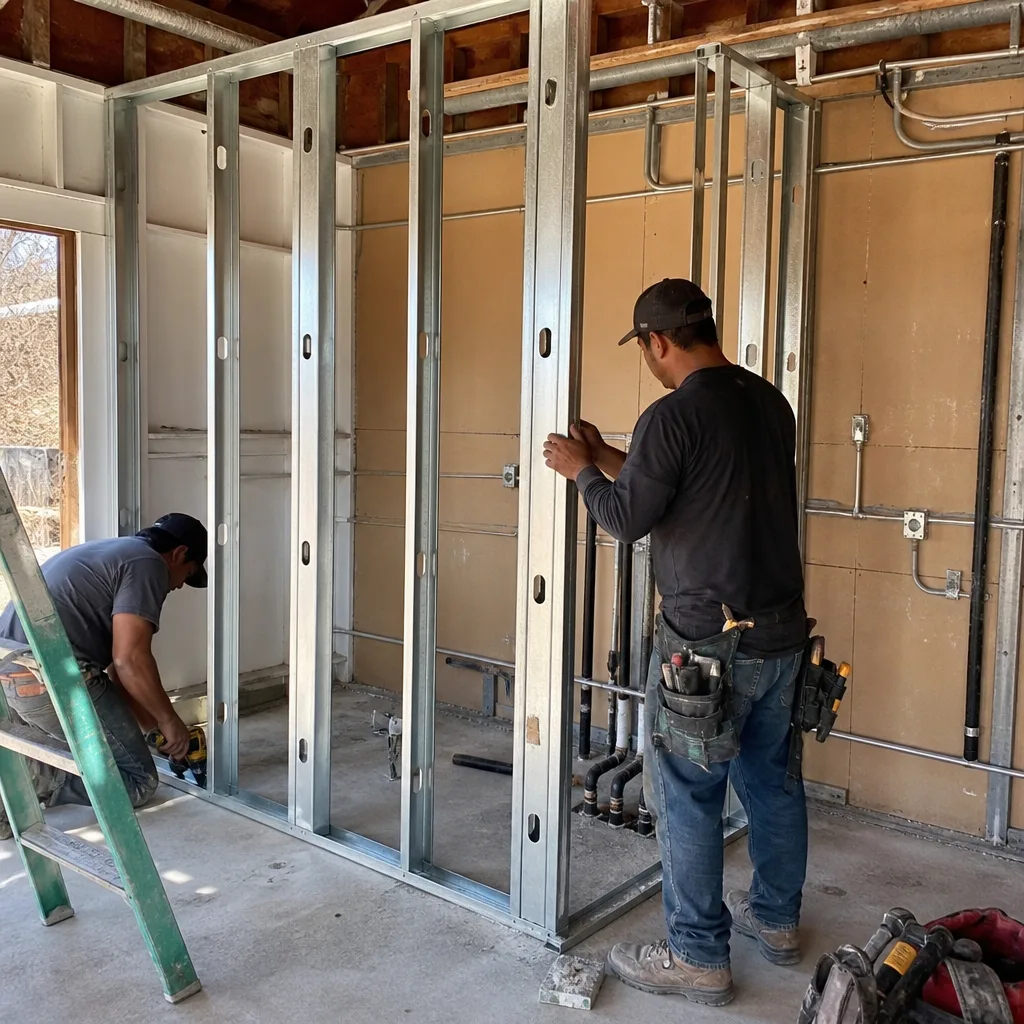
Call a design-build professional when your project involves structural modification, new utility connections, or any work requiring a building permit. In Pomona, this includes every ADU type: garage conversions, new detached units, junior ADUs, and interior conversions with separate egress. The city’s minimum threshold for permit exemption is cosmetic work only - paint, flooring, cabinet replacement without plumbing relocation.
Specific scenarios that demand professional involvement: your garage slab is cracked or less than 4 inches thick; your electrical panel is rated below 200 amps; your property slopes more than 2 feet across the build area; your sewer lateral is original clay pipe; or your lot is in a Pomona historic district with additional design review. Each of these conditions triggers code requirements that owner-managed projects routinely underestimate.
Ellery ADU Studio Pomona offers free estimates in Pomona. We also provide a Free Second Opinion on any written estimate already in hand - we’ll review the scope, the allowances, and the permit strategy, with no obligation to hire us. Call (657) 286-7915 to schedule.
Frequently Asked Questions
Garage conversion ADUs in Pomona typically run $95,000-$165,000 all-in, while new detached ADUs range $185,000-$320,000 depending on size, site conditions, and finish level. Every Ellery project receives a written price before work begins. Call (657) 286-7915 for a project-specific estimate.
Yes. Every ADU in Pomona requires a building permit, and most require separate plumbing, electrical, and mechanical permits. Detached ADUs also need planning approval for setback and coverage compliance. Pomona’s Community Development Department at 505 S. Garey Avenue processes all ADU permits; plan check typically takes 15-25 business days for a complete submittal.
A B (General Building) license authorizes oversight of the complete ADU project, including structural, but requires subcontracting electrical, plumbing, and HVAC to appropriately licensed trades. A C-36 (Plumbing) license alone cannot legally perform structural framing or general construction. Verify that your contractor’s license classification matches the work they propose to self-perform.
From permit issuance to final inspection, garage conversions typically take 3-5 months and new detached ADUs 6-10 months in Pomona. Prefab and modular units may reduce on-site construction time but do not accelerate city plan check or utility connection scheduling. A contractor who promises significantly faster timelines is likely excluding permit or utility timelines from their estimate.
Under a properly structured fixed-price contract, the price changes only when defined triggers occur: concealed conditions, owner-requested modifications, or code changes after permit issuance. Under Haven Standard Clause 5, Ellery locks the scope at signing; undefined conditions are our responsibility, not yours. Always read the change-order trigger language before signing any contract.
Ellery pulls all permits as the licensed contractor of record. We do not ask homeowners to act as owner-builders. Our license number appears on every Pomona permit, and we maintain responsibility for scheduling inspections, correcting code violations, and obtaining final sign-off. This single-point accountability is the core of our design-build model.
Request Pomona-specific permit numbers and verify them on the city’s public portal or at the Community Development counter. Ask for the addresses of completed projects, then search those addresses in the permit database. A contractor with genuine Pomona experience will provide this information readily; one who deflects or offers only “Los Angeles County” references likely lacks Pomona-specific knowledge.
The Bottom Line
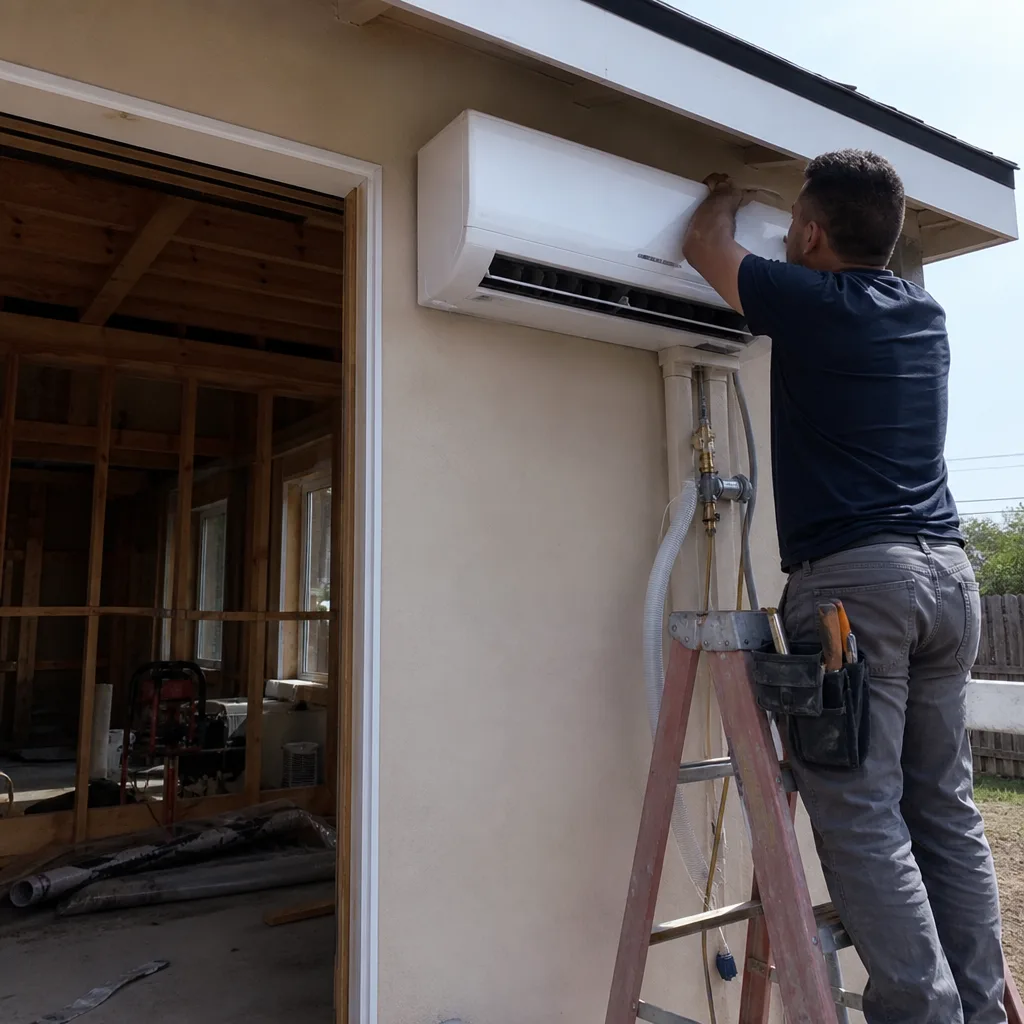
Hiring an ADU contractor in Pomona is not a bidding exercise. It is a verification exercise: of license classification, of permit completion history, of contract structure, and of specific city knowledge. The contractor who stamps the drawings should be the same entity legally accountable for building to them. Anything else creates a liability gap that you, the homeowner, will pay to close.
Start with the contract structure. Verify the license. Read the permit history. Demand written pricing with defined change-order triggers. And ask the questions that reveal whether a firm has actually navigated Pomona’s specific requirements - not once, but repeatedly, with documented results.
Written by Nadia Ellery, Owner at Ellery ADU Studio Pomona, serving Pomona since 2015.