
Title 24 Energy Compliance in Pomona, CA
Title 24 energy compliance is a mandatory California code requirement that every new ADU and most substantial conversions must satisfy before the city issues a building permit. In Pomona, that means producing a certified CF1R compliance report, sizing your insulation and mechanical systems to meet the California Energy Code, and having those calculations reviewed alongside your permit set. Ellery ADU Studio handles every piece of that documentation in-house through our ADU Design & Permitting services, so there is no back-and-forth between a designer who doesn’t understand energy modeling and a third-party consultant who has never seen your site.
If you’re early in the planning process, our full ADU Design & Permitting in Pomona page explains how Title 24 fits into the complete permit set we produce for every project. Or, if you’re ready to talk numbers, call us directly at (657) 286-7915 – a live person picks up, every time, no voicemail queue. Nadia Ellery and the Ellery ADU Studio team have been producing permitted ADU sets in Pomona since 2015, and the energy compliance report is treated as a core deliverable, not a last-minute box to check.
When You Need Title 24 Energy Compliance
California’s Energy Code applies broadly, but here are the specific situations where Pomona homeowners most often need a Title 24 compliance report prepared and submitted:
- You’re building a new detached ADU. Any new structure requires a full CF1R energy report covering envelope insulation, window performance (U-factor and SHGC ratings), air sealing, and mechanical equipment. In Pomona’s Inland Valley climate zone (CEC Climate Zone 10), summer cooling loads are the dominant compliance driver, and sizing a mini-split or HVAC system without the energy model first is a common and costly mistake.
- You’re converting a garage to a living unit. A garage conversion triggers Title 24 because you’re changing the occupancy classification. The existing slab, framing, and roof assembly all get evaluated. Many Pomona garages built before 1990 have zero wall insulation, which the energy calculation must account for and correct.
- You’re adding a Junior ADU inside the existing house. Interior conversions still require an energy analysis if the scope includes new mechanical equipment, new windows, or wall assembly changes. The threshold is lower than a full build, but the documentation is still required for permit issuance.
- Your building department issued a plan check correction citing energy compliance. Pomona’s Building and Safety Division flags Title 24 deficiencies at the plan check stage. If your permit set came back with a correction letter referencing energy code sections, the fix is a compliant CF1R report, not a revised floor plan.
- You’re specifying a prefab or modular unit. Factory-built ADUs like those from Plant Prefab or Boxabl ship with their own energy documentation, but that documentation must be adapted to your specific Pomona lot, orientation, and utility connection. A modular unit placed facing due west on a Garey Avenue property has a different cooling load profile than the same unit on a north-facing lot in the Arroyo neighborhood.
- You received a written estimate from another firm that doesn’t include energy compliance. This is more common than it should be. Some Pomona design firms price the architectural drawings and treat Title 24 as an add-on billed separately after permit submission. If you have an estimate in hand, bring it in – we offer a Free Second Opinion and will tell you exactly what’s missing.
Our Title 24 Energy Compliance Process
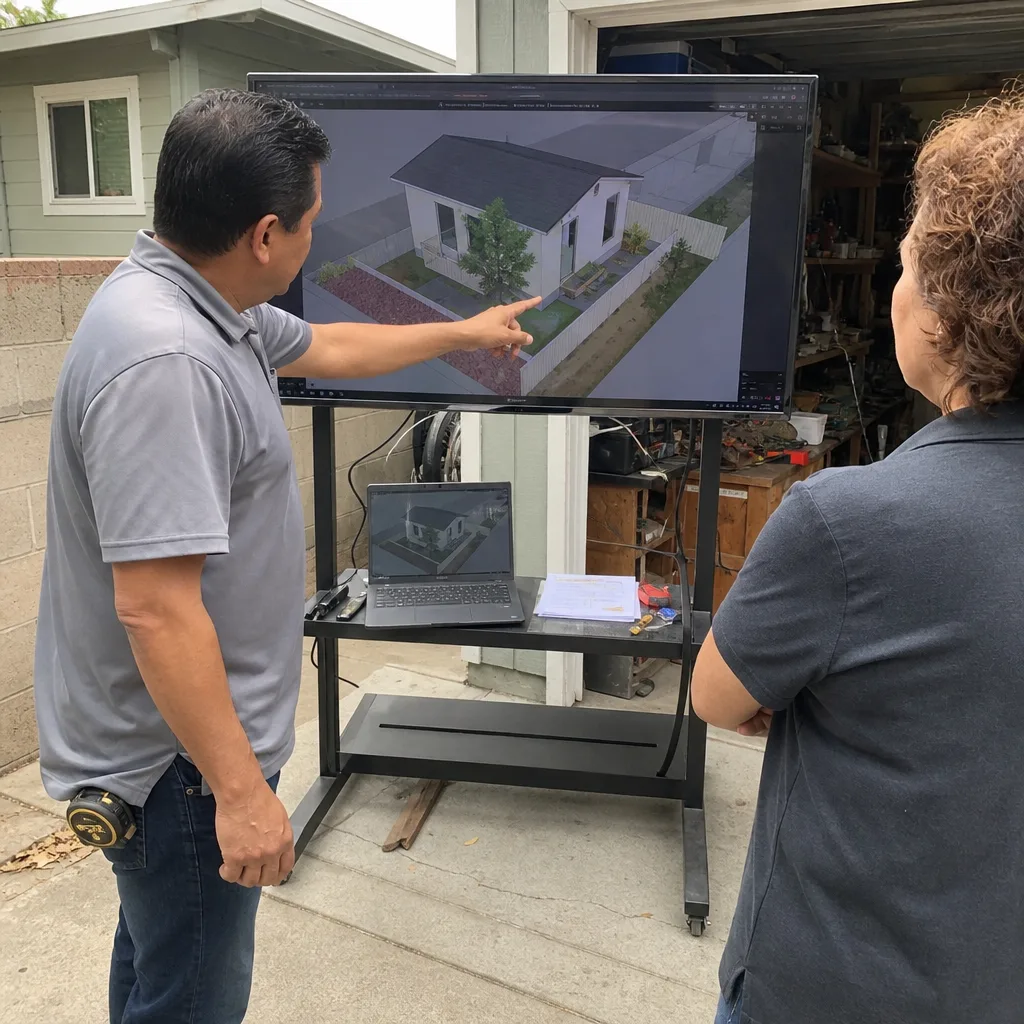
Ellery ADU Studio runs Title 24 energy compliance as an integrated step inside our ADU Design & Blueprints permit set, not as a parallel track. Here is exactly how it works on a Pomona project:
- Site and orientation assessment. Before the energy model opens, we document your lot’s compass orientation, shading from adjacent structures or mature trees, and the utility provider (Southern California Edison for most of Pomona). Orientation affects window SHGC requirements significantly in Climate Zone 10 – a west-facing glazing assembly that passes compliance on one lot may fail on the lot next door.
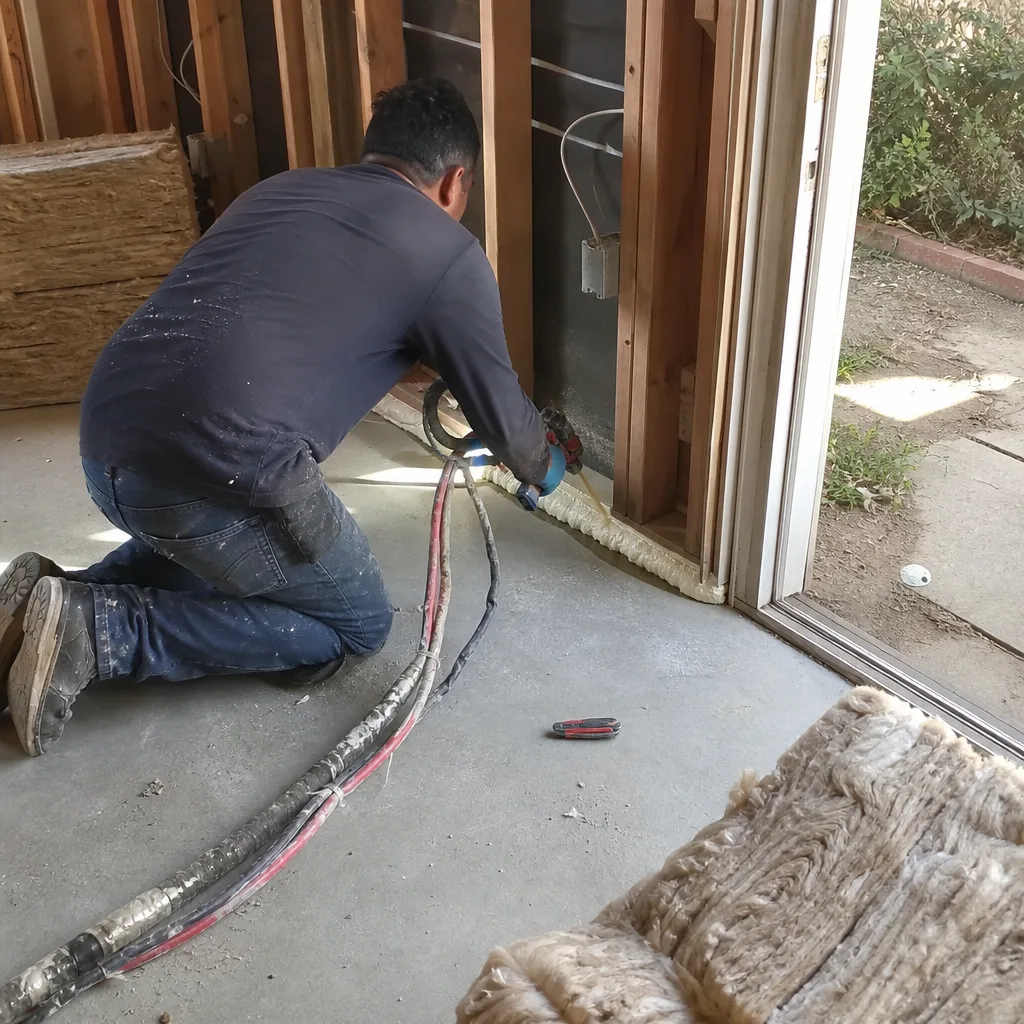
- Envelope specification and insulation sizing. We determine wall, roof, and floor insulation values to meet or exceed the prescriptive path in the Energy Code, then cross-reference them against the existing assembly if you’re doing a conversion. For garage conversions in Pomona, we almost always recommend spray foam in the ceiling cavity rather than batt insulation because the existing framing depth is usually insufficient for a standard R-38 batt assembly.
- Mechanical equipment selection and compliance modeling. We run the energy model in certified software (EnergyPro or equivalent) to confirm that the HVAC equipment you’re specifying – typically a ductless mini-split for a single-room ADU – meets the efficiency minimums and that the building’s total energy budget clears the compliance threshold. This step is where the CF1R form is generated.
- CF1R report preparation and HERS registration. The Certificate of Compliance (CF1R) is the document the City of Pomona’s Building and Safety Division reviews. We prepare the report, register it with the HERS (Home Energy Rating System) provider, and include it in the permit set you submit. The CF2R and CF3R field verification forms are also specified at this stage so you know what inspections to schedule during construction.
- Plan check integration and correction response. If the building department issues a plan check correction touching energy compliance, we respond. That is included. We do not bill hourly for correction responses on projects we permitted – the written price you received at the start covers the complete permit set through issuance, per Haven Standard Clause 1.
- Field verification coordination. After permit issuance, a HERS rater must physically verify certain measures – duct leakage, refrigerant charge, and insulation installation quality are the most common. We document the required verifications in the construction package so your crew knows exactly what needs third-party sign-off before the final inspection.
Title 24 Energy Compliance Pricing in Pomona
Title 24 energy compliance is included in Ellery ADU Studio’s all-in permit-set price. We don’t sell it as a standalone service with a separate invoice that shows up mid-project. That said, here are the realistic cost ranges for the energy compliance component when you’re evaluating How Much Does ADU Design & Permitting Cost? (2026 Price Guide) - Pomona, CA for a complete permit set:
| Project Type | Energy Compliance Component Range | Notes |
|---|---|---|
| New detached ADU (400-1,200 sq ft) | $900 – $1,800 | Full CF1R report, HERS registration, and plan check support included |
| Garage conversion ADU | $700 – $1,400 | Existing assembly evaluation adds time; insulation corrections often required |
| Junior ADU / interior conversion | $500 – $900 | Scope-dependent; lower if no new mechanical equipment |
| Prefab / modular coordination (Plant Prefab, Boxabl, etc.) | $600 – $1,100 | Adapts factory documentation to Pomona site-specific conditions |
These ranges reflect what Pomona permit sets have run since 2015. The variables that push cost toward the top of the range: complex roof geometry (common in the older craftsman stock near Lincoln Park), west-facing glazing that requires performance-grade windows to pass compliance, and projects that require multiple HERS field verifications rather than the standard one or two.
Under Haven Standard Clause 1, every Ellery ADU Studio project receives a written price before any work starts. Energy compliance is a line item in that written price, not a surprise that appears when the permit set goes in. Call (657) 286-7915 for a free estimate from ADU Design & Permitting Near Me in Pomona, CA – the price you receive in writing is the price you pay.
Why Pomona’s Climate Zone Makes Title 24 More Demanding Than Coastal ADU Projects
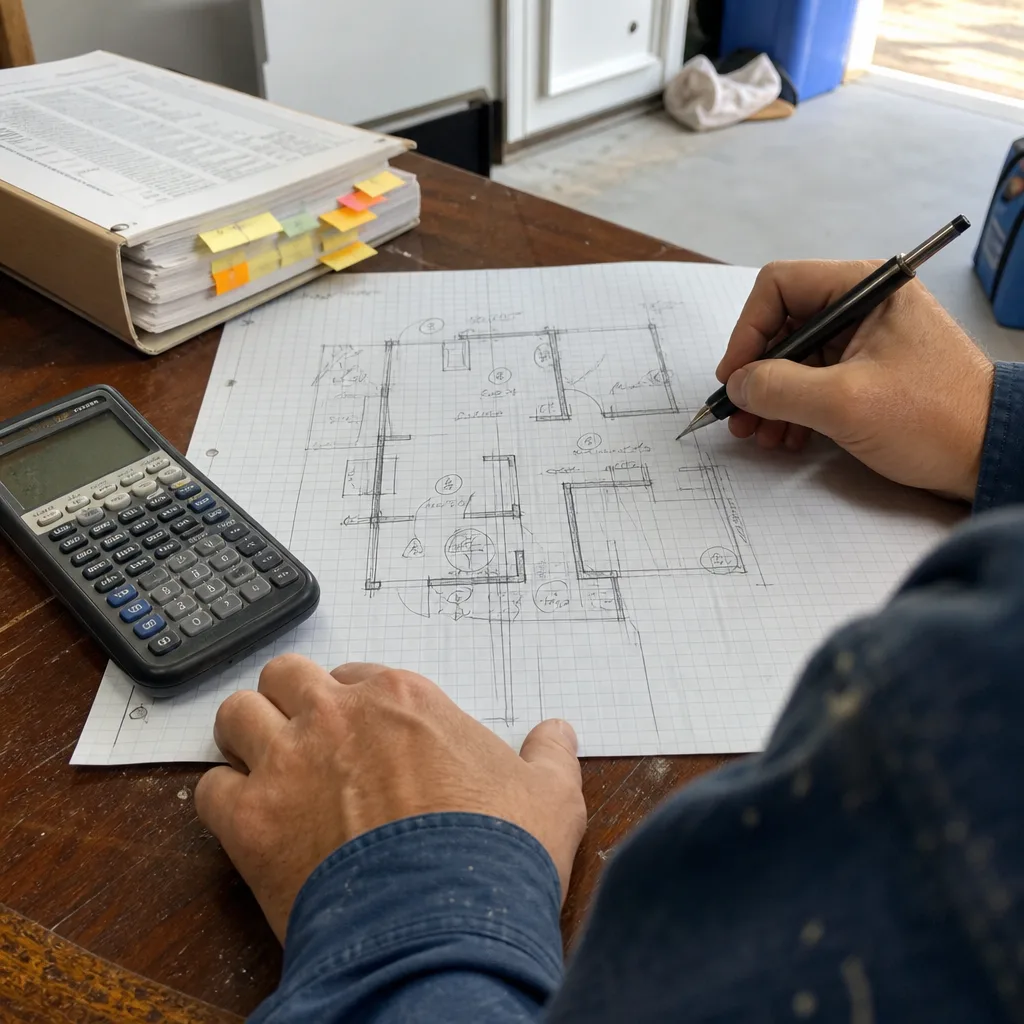
Pomona sits in California Energy Commission Climate Zone 10. That distinction matters more than most homeowners realize when they compare notes with friends in Los Angeles proper or the South Bay.
Climate Zone 10 runs from the eastern San Gabriel Valley through the Pomona Valley and into the Inland Empire. Summer design temperatures in Pomona regularly reach 100-105°F, compared to 75-80°F in coastal Zone 7 and 8 markets. The energy model has to account for that heat load, which means the compliance path for cooling is substantially more constrained. Specifically:
- Window SHGC (solar heat gain coefficient) requirements are tighter on west and south exposures – a window assembly that passes compliance in Santa Monica may fail at a Pomona plan check.
- Cool roof requirements apply to low-slope assemblies and are frequently triggered on the flat-roof detached ADUs that are popular in Pomona’s South Garey and Vejar neighborhoods.
- Mechanical efficiency minimums push many projects toward high-SEER mini-split systems even when a simpler heating solution might otherwise suffice.
- Air sealing verification is a required HERS measure on most new construction – Pomona’s dry, dusty air infiltration environment makes the building department take this seriously.
None of this is a problem if the energy compliance is handled correctly from the first draft. The issue arises when a designer produces architectural drawings without running the energy model first, and then the mechanical engineer or HVAC contractor discovers mid-construction that the window package doesn’t comply. That correction at the construction stage can mean window replacements, which is an expensive and avoidable problem.
Ellery ADU Studio runs the energy model during the design phase, before the drawings are finalized, so the window schedule and insulation spec in the permitted drawings are the ones that actually comply. That’s not a marketing claim – it’s the documented sequence in our permit set process, and it’s why our plan check correction rate on energy issues is low across the 900-plus ADUs we’ve permitted since 2015.
James Hardie Siding, Insulation, and the Compliance Interaction Most Designers Miss
If your ADU design includes James Hardie fiber cement siding – which we specify often because it performs well in Pomona’s hot, dry summers and handles the freeze-thaw range in the Pomona hills – there’s an insulation interaction worth understanding.
Fiber cement cladding is non-insulating by itself. That’s fine and expected, but some design teams mistakenly specify thinner continuous insulation (rigid foam) behind the James Hardie panels, assuming the cladding adds thermal resistance. It doesn’t. The energy model treats the wall assembly as its actual R-value, and if the rigid insulation layer is undersized, the CF1R report fails the compliance check.
We specify the insulation layer first, confirm compliance in the energy model, then select the James Hardie profile and finish that works aesthetically within the compliant wall thickness. That sequence takes an extra conversation during schematic design, but it eliminates a plan check correction that would otherwise cost two to four weeks of delay at the City of Pomona’s Building and Safety Division.
What You Receive at the End of Title 24 Compliance Work
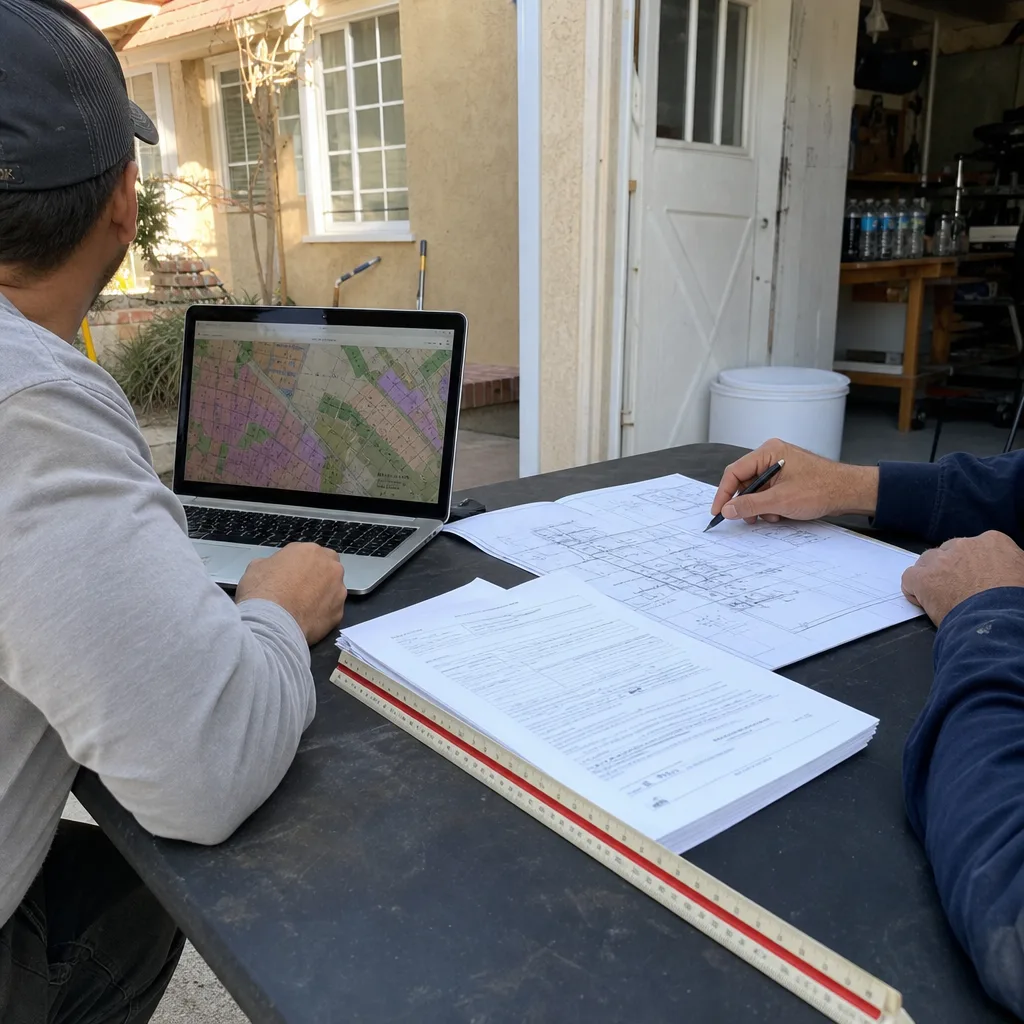
Documentation is what changes hands at the end of a Title 24 process, and knowing what you’re entitled to receive matters. Ellery ADU Studio delivers:
- Registered CF1R report – the Certificate of Compliance, registered with a HERS provider and accepted by the City of Pomona. This is the document that satisfies the plan check energy requirement.
- Compliance notes embedded in the permit drawings – the energy notes page of your permitted set references the CF1R registration number, the insulation specifications, the window schedule U-factors and SHGC values, and the mechanical equipment efficiency ratings. Everything is cross-referenced so there is no ambiguity during inspection.
- CF2R installation certificate template – filled out by the contractor during construction to document that insulation, windows, and mechanical equipment were installed per the compliance report.
- CF3R field verification checklist – specifies exactly which HERS rater verifications are required before the final inspection. No surprises for the crew on the day of the final.
- Documented photo record – per The Haven Standard, every site visit is documented with photographs. If we visit the Pomona site to verify existing conditions before the energy model, those photos are yours to keep.
Under the 365-Day Done Right Promise, if the finished ADU is not built to the permitted drawings – including the energy compliance specifications embedded in those drawings – Ellery ADU Studio makes it right. That promise is in writing before the project starts, not offered after a problem surfaces.
FAQs – Title 24 Energy Compliance in Pomona
What exactly is a CF1R and why does Pomona require it?
A CF1R is the Certificate of Compliance required by California’s Title 24 Energy Code – it documents that your ADU’s design meets the state’s minimum energy performance standards for insulation, windows, air sealing, and mechanical systems. Pomona’s Building and Safety Division requires the CF1R to be registered with a HERS provider and included in the permit set before they can issue a building permit. Without it, the permit application is incomplete regardless of how good your architectural drawings are. Call us at (657) 286-7915 and we’ll confirm exactly what your project type requires – the estimate and the documentation list are both free.
Can I use the Title 24 report from a manufacturer like Plant Prefab or Boxabl instead of doing my own?
Factory-built ADUs from manufacturers like Plant Prefab and Boxabl ship with energy documentation, but that documentation is generic – it reflects the unit as it left the factory, not how it performs on your specific Pomona lot with your specific orientation and utility connection. Pomona plan check requires a site-specific CF1R, which means the factory documentation has to be adapted rather than submitted as-is. Ellery ADU Studio handles that adaptation as part of the permit set – we take the manufacturer’s baseline data, run it through the energy model for your site conditions in Climate Zone 10, and produce the registered CF1R the building department needs.
How long does Title 24 compliance add to the permitting timeline in Pomona?
When energy compliance is handled in parallel with architectural design – which is how we run it – it adds no time to the permitting timeline. The CF1R is ready when the drawings are ready. Where it adds time is when it’s treated as a sequential step: drawings done, then energy compliance, then submission. That approach can add two to six weeks to a Pomona project. The other timeline risk is a plan check correction citing energy deficiencies – those corrections typically add three to five weeks because Pomona’s plan check queue restarts. We reduce that risk by running the energy model before the drawings are finalized.
Is Title 24 energy compliance required for a Junior ADU that doesn’t change the exterior?
Usually, yes – if the Junior ADU scope includes new mechanical equipment (a mini-split, for example), new windows, or changes to the wall or ceiling assembly, Title 24 applies and a compliance report is required. A pure interior conversion that touches none of those elements may qualify for a reduced scope, but Pomona’s Building and Safety Division makes that determination at plan check. We evaluate the specific scope of your project during the estimate phase and tell you exactly which compliance documents are required before any work starts, per Haven Standard Clause 1.
Key Takeaways
- Title 24 energy compliance is required for all new ADUs and most conversions in Pomona, and must be submitted as part of the permit set.
- Pomona’s Climate Zone 10 location makes the energy compliance requirements more demanding than coastal California cities – particularly for cooling loads and window performance.
- Ellery ADU Studio includes Title 24 compliance in the all-in permit set price – it is not billed as a separate add-on after submission.
- The energy model runs during design, not after, so window schedules and insulation specs in the permitted drawings are the ones that actually comply.
- You receive the registered CF1R, the embedded compliance notes in the permit drawings, and the CF2R and CF3R field verification documents.
- The written price you receive before work starts covers energy compliance through permit issuance and plan check correction response, per Haven Standard Clause 1.
If you’re ready to discuss your Pomona ADU project, or if you have a written estimate from another firm that doesn’t clearly itemize energy compliance, call Ellery ADU Studio at (657) 286-7915. Nadia Ellery’s team answers live – no voicemail, no callback queue – and the Free Second Opinion on any existing estimate costs you nothing. For the full picture of how Title 24 fits into the complete permit process, visit our ADU Design & Permitting in Pomona page. Every project starts with a written price before any work begins.
Written by Nadia Ellery, Owner at Ellery ADU Studio Pomona, serving Pomona.